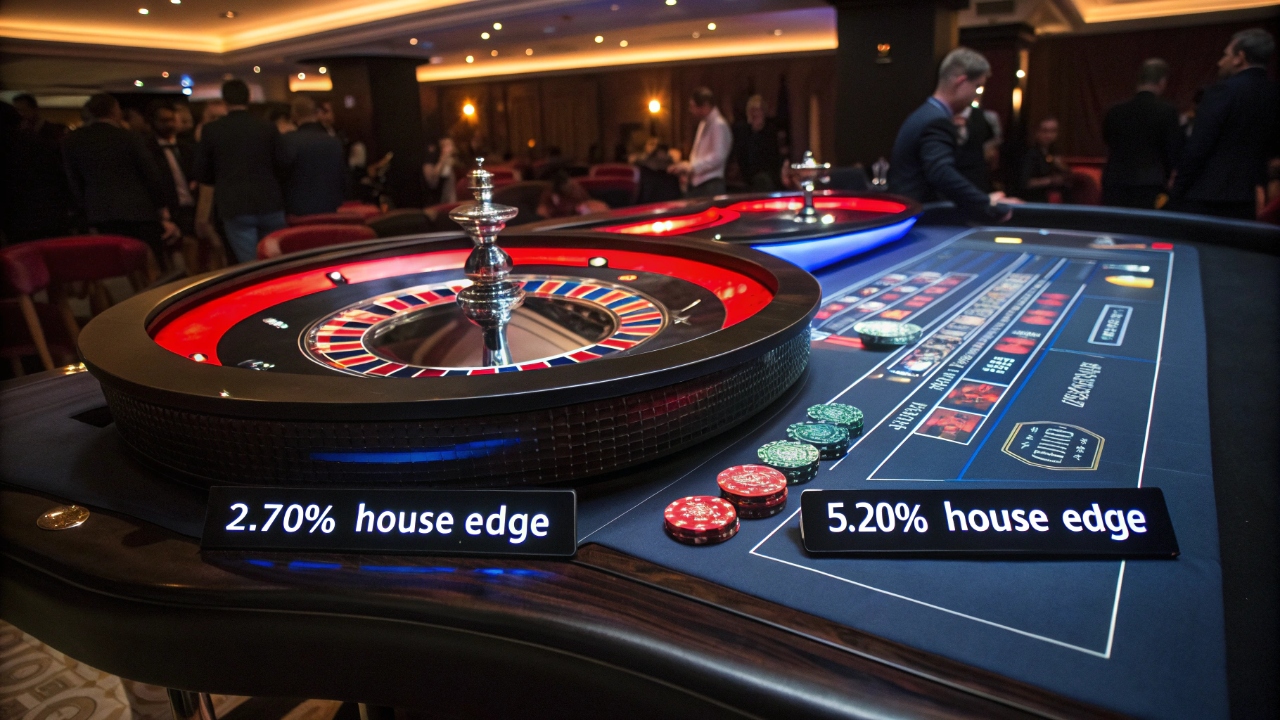
Online roulette remains one of the most recognizable casino games, but behind its apparent simplicity lies an important mathematical difference between its main versions. Players often focus on table design, round speed, or interface, yet the key factor in profitability is tied to the number of pockets on the wheel. The wheel’s structure determines how large the house edge is over time and what odds the user gets with identical bets. When comparing European and American formats, the impact on bankroll can be noticeable, especially during long sessions.
Why Wheel Type Determines Long-Term Results
European roulette uses a wheel with 37 pockets: numbers 1 to 36 and a single zero. The American version has 38 pockets because, in addition to the standard zero, it includes a double zero. At first glance, a difference of just one pocket may seem minor, but this is exactly what increases the house advantage on every spin. Payouts for most bets remain the same in both versions, so the extra pocket in American roulette is not offset by higher odds.
This creates a basic effect: under equal conditions, players lose less in European roulette in terms of expected return. In the short run, outcomes always depend on variance and lucky streaks, but over a large number of spins, statistics begin to favor mathematics. That is why choosing a roulette version is not a matter of taste, but of probabilistic efficiency.
The Math of Odds: Where the House Edge Is Lower
Strictly speaking, the house edge in European roulette is about 2.70%, while in American roulette it is about 5.26%. That is nearly a twofold difference, and it is critical for regular players. For example, with the same betting volume, expected losses in the American format will be significantly higher over time, even if strategy and stake size are identical.
The RTP metric, or theoretical return to player, also confirms this conclusion. A European table is close to 97.30%, while an American table is around 94.74%. A gap of several percentage points is considered substantial in casino mathematics. It does not guarantee a win in a specific session, but it reduces the average speed of bankroll decline under equal activity. That is why players who take a rational approach more often choose the European layout as the gentler option.
How This Affects Practical Online Play
In real online casinos, both formats may look similar: familiar betting layout, standard outside bets, and similar game pace. However, final results under the same discipline usually diverge because of the built-in margin. When a user places many bets on even/odd, red/black, or ranges, the difference between one zero and two zeros becomes especially clear. Visually, it is the same game, but financially, it is a different model.
The specific table rules also matter. Some versions of European roulette include conditions such as partial stake returns in certain zero outcomes, which further reduces the effective house margin. American tables offer such mechanics less often and, on average, remain less favorable for players. For this reason, before starting a session, it is important to check not only limits and dealer speed, but also the rules listed in the game information panel.
Which Format to Choose If You Care About Probability
If the goal is better odds and longer bankroll sustainability, European roulette is almost always the better choice. It offers higher RTP, lower house edge, and softer long-term math. The American format may still be interesting for variety or personal preference, but in terms of probability, it is objectively weaker because of the double zero.
The main practical takeaway is simple: always check the wheel type before betting, because this detail determines the game’s fundamental value. When a player consciously chooses European roulette and controls bet size, luck is still a factor, but the game shifts into more rational conditions. In online gambling, where every percentage point matters, this approach provides a meaningful advantage in risk management and bankroll preservation.